
Category: Uncategorized

  • The Journey to Safer Roads

    The Journey to Safer Roads

    This May, the Transportation Association of Canada (TAC) announced the four winners of its annual Technical Achievement Awards. A team from the BC Ministry of Transportation and Infrastructure, facilitated in partnership with Urban Systems’ certified adult educator Pam Robertson, will receive the TAC Educational Achievement Award at this year’s fall conference. This year’s award was submitted under the BC Ministry of Transportation and Infrastructure for the 2018/2019 Highway Maintenance Contract Training Course. The award recognizes a TAC member organization for outstanding contributions in education and training through an in-house or external program. Winners have demonstrated one or more noteworthy elements of innovation, verifiable payoff, widespread recognition, improved skill sets or practices, or have provided a foundation for better business practices.
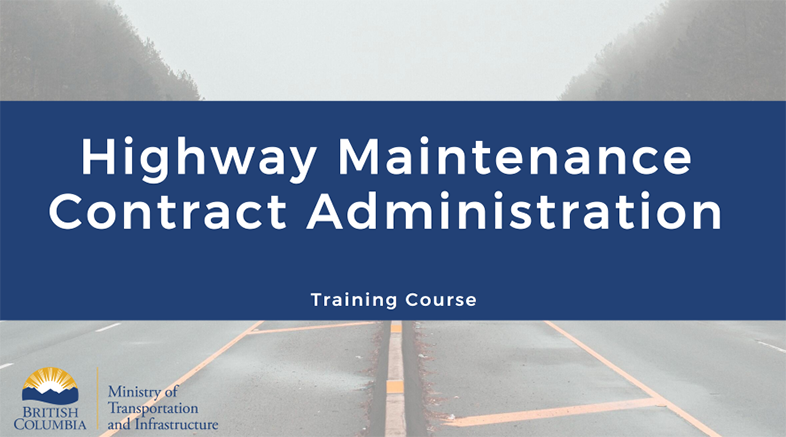
    Since privatizing highway maintenance in 1988, the Ministry has selected highway maintenance contractors who provide services through progressively longer-term agreements totaling about $400 million a year. The Ministry recognized that it would be critical for staff and maintenance contractors to be aligned and working well together if the agreements are to be successful over the course of their 10 to 15-year partnership. As a result, the Ministry took the unprecedented step to develop and deliver a specialized training course for Ministry staff and maintenance contractors designed to build their knowledge and skills for fulfilling their roles, develop a common understanding of the agreement, and establish positive working relationships from the start of the agreement.

    Dan Palesch, the Director of Highway Maintenance Contract Renewal, shared that the Ministry brought Urban on board “Because none of us are course developers. When we decided to do this training, we were really struggling with how to get started. Anyone can put together a PowerPoint, but not everyone can put together an effective training course.”
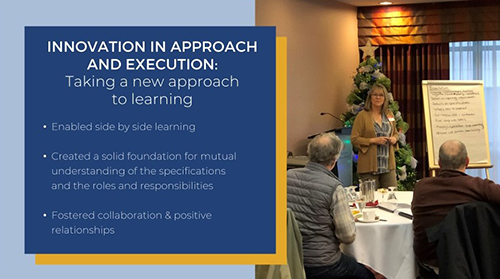
    “The difference in bringing Pam on board was having a successful course and a un-successful course”, Dan continued, “It helped us come to understand how to go out and stand in front of a group of people and actually teach them something, instead of just being a talking head. It also provided a duel benefit, by not only helping us understand how to successfully train adult learners, but professionally facilitating the training sessions”.

    The approach of owner and contractor learning side-by-side is innovative for this industry. Course participants, including Argo Road Maintenance, found it to be very successful. Sandi Paulsen, from Argo’s team, shared “we found value in participating in this course to reinforce and learn the changes and requirements contained within the new maintenance contracts. Expanding the training to include administrative and support staff provides a broader context and the ‘why’ beyond some of the requirements, which is beneficial to all”.

    A training team consisting of Pam, alongside Ministry subject matter experts Ian Pilkington, Dan Palesch, Christina Klatt and Joey Vaesen, worked closely to design, develop and deliver two-days of in-class training to support Ministry staff and successful highway maintenance contractors in administering and implementing the new agreements.

    The course was designed to use a variety of instructional techniques to support a diversity of learning styles including small group hands-on activities, large group discussions, videos, presentations, and learner workbooks & handouts. A total of 421 participants, including 220 Ministry staff and 201 contractor representatives, participated in the training delivered in 26 of the Ministry’s 28 service areas across the province. The training was designed to create mutual understanding for the agreement and foster collaboration and relationship building between Ministry staff and the maintenance contractors they work with.

    “Although the logistics and delivery were of the highest quality, it was the lasting relationships formed as a result of the training that can truly speak to its value. It was clear that this training was designed to promote an atmosphere of partnership among attendees,” Elcy LePage of Dawson Road Maintenance shared. “For us […] the training also provided a wonderful opportunity to build community relationships. Since the course, we have been able to collaborate with the Ministry in advancing our social responsibility goals and we look forward to leveraging this partnership to become an even better corporate citizen.”

    Beyond relationship building, Dan shared that “If you asked me three years ago if I would ever go up and facilitate several 2 day training courses, I would have said you’re crazy. It was definitely out of my comfort zone. I’ve learned a lot about how to stand up in front of large groups of people and feel  confident while delivering hours and hours of training. One of the interesting challenges when you are going through something like this over a long period of time is how many factors can change. There are these challenges that come along, such as staff transitions and technical difficulties that can really test you, but the ability to overcome adversity and still have fun over the course of this training was a highlight. You just learn to adapt; overall it was a very successful initiative.”

    Pam and the Ministry’s training team will be presenting this adult education program at the upcoming 2020 TAC Conference & Exhibition, held online from September 21st – October 8th. The team’s presentation is scheduled for September 22 at 2:00 p.m. PST.
  • Creating a Culture of Resilience

    Creating a Culture of Resilience

    In her new role as Culture & Strategy Lead for Urban Matters, Delyse Sylvester recently reached out to Urban Systems CEO Martin Bell to discuss Urban Matters’ genesis — and how it continues to contribute to a culture of resilience and intrapreneurship at Urban Systems.

    A decade ago, says Martin, “we were operating on a hero-based leadership style, with very few people expected to carry the whole thing, top-down. And that was very, very heavy.”

    In the intervening 10+ years, Urban has worked hard to shift from that ruggedly individualistic leadership style to one that’s more collaborative, where people at all levels are empowered to bring their diverse skills and passions to the table.

    Martin Bell

    As Urban Systems began that shift in 2008, one of its C-suite leaders and engineers was undergoing a similar, parallel metamorphosis. “Some people might jokingly call it a midlife crisis,” observes Bell about his colleague Ken Gauthier’s journey, “but I think it was a profound questioning of his purpose, and the value of the work he was doing versus the value of the work that he could do.”

    That crisis of conscience led Gauthier to found Urban Matters. The “community contribution company” (CCC) was incorporated to generate new opportunities and outcomes in the social- and community-service sectors. Urban Matters acts as an innovation hub, working with citizens, municipalities, governments, not-for-profits, NGOs, First Nations, social entrepreneurs and businesses to address complex social issues, like opiate addiction, homelessness, teen suicide epidemics, poverty, climate change — or global pandemics.

    Ken Gauthier

    Strikingly, Gauthier didn’t have to leave Urban Systems to create Urban Matters. Instead, he chose to stay within it, capitalizing on the company’s wealth of talent and skill — and also challenging it to shift, to embrace disruption and uncertainty.

    For its part, the parent company made the (at times controversial) decision to support this unknown quantity.

    “I’m not going to lie: it was a hard sell at times,” says Bell. “But people were also excited about the idea of contributing to communities in more meaningful and diverse ways. The issues we were dealing with were becoming stickier and more complex; they couldn’t be solved with a pipe in the ground or change in water pressure. And there seemed to be a lot of potential in creating something that would allow us to apply our skills for good in less familiar arenas and with less traditional partners. I don’t think we understood then how valuable our own skills and networks were to meeting social purpose. Urban Matters showed us that.”

    It’s noteworthy, he points out, that Urban Matters is not Urban Systems’ charitable arm. It develops funding for its initiatives, and invests in and shares profits with the communities it serves. “Urban Matters is financially sustainable all on its own, while also creating opportunity for Urban Systems.”

    A central tenet of Urban Matters involves including people with lived experience in the process of developing solutions to systemic problems. That might mean recruiting people with experience of addiction to help craft a municipal response to the opioid crisis, or convening conversations with people who are or have been homeless to provide insider knowledge on a community housing strategy.

    That focus on community, says Bell, is in the firm’s agrarian DNA: “Most of the gang that started Urban Systems in the 70s were farm kids from the Prairies. So, they have that streak of individualism and industriousness, that resilience, but they also have that sense of community-mindedness that you see in the agrarian tradition. There’s an understanding that you band together when there’s need in the community, and you do that for the broader good.”

    Urban Systems, says Bell, saw in creating Urban Matters an opportunity for more than simple corporate social responsibility. Rather than just write cheques to good causes, “we were seeking to empower our people to build their skills, to take those skills back to communities, to work together in arenas that mattered to them”.

    “Lots of decision-makers were talking about doing that kind of thing, but nobody was actually doing it,” he says. “Our clients wanted meaningful engagement with the communities they lived and worked in. And we asked, ‘How do we actually do it? How can we help our clients make the community impact they really want to make?’ We are showing that these things are possible through our partnerships with Urban Matters. It’s part of an ecosystem of social contribution, where the two organizations adapt to and play off each others’ strengths.”

    Urban Matters, says Bell, is a tangible and prominent testament to the firm’s real commitment to intrapreneurship, at every level:

    “We chose to make the transition in our leadership and structure because we felt it was a successful business approach, especially with younger generations coming on board,” he says. “They don’t want to wait until they retire to make a difference. They want to do it now, and so do we.”

    Urban Matters, says Bell, is transforming its parent company from within. “We are better regarded in the eyes of our clients. We lead better. We create more effective solutions. We are so much more resilient today than we were 10 years ago. There are more eyes on the street, more people committed to each other’s success. It’s lighter, because there are just so many more hands lifting us.”

    “What Urban Matters has shown Urban Systems is that we are part of a community, and that when we take seriously the diverse, lived experience of our community members, we create a better culture.”

  • Planning in the Parkland

    Planning in the Parkland

    Gentle, rolling hills. Clear lakes and running streams. Dense forests and bountiful grasslands that expand across the horizon ad infinitum. The natural beauty contained within Manitoba’s Parkland region is well known to a select few, but for many others it is their next adventure to discover. Made up of 16 municipalities, the Parkland is home to many vibrant and livable communities, thanks in large part to the community planning work of municipal governments and other passionate Manitobans.

    Over the last few years, Urban Systems has been lucky to collaborate with several local governments in the Parkland region to deliver innovative and meaningful projects in the realms of land use planning, active transportation, street design, asset management, and municipal policy.

    Jamie Hilland and Ryan Segal, Winnipeg-based planners at Urban Systems, recall driving from Winnipe to the Parkland in 2019 to meet with local governments and talk about their communities. “We know the area well. My family is from the Town of Roblin (‘The Jewel of the Parkland!’). Growing up I spent all my summers there, and I still spend part of the summer at our family cottage at Madge Lake,” Jamie says. “One day, Ryan and I just decided to hop in a car and spend two days meeting communities in person. We had some great conversations about what was going on in their municipalities, as well as their current issues and opportunities.”

    Jamie Hilland – Sustainable Transportation Planner

    Those initial conversations soon evolved into several exciting projects for the region. In 2020, Urban Systems worked with the City of Dauphin to develop the City of Dauphin Active Transportation Strategy: a project to create an integrated active transportation network for the city of 10,000 people. Prioritizing citizen safety, community health, air quality, and quality of life, the proposed AT network will connect all neighbourhoods in the city and will improve the accessibility of all pedestrian and cycling infrastructure.

    “We had great public engagement and input from stakeholders,” says Jamie. “It is a really solid strategy that the City is quite pleased with. I think that Dauphin will demonstrate what improving the pedestrian and cycling realm can do to benefit a community and its liveability.”

    The Active Transportation Strategy is in its final stages before presentation to City Council in early 2021. Urban Systems also provides

    ongoing technical support for Dauphin, including detailed design services for a new multi-use path and cycling facility in the city’s centre, as well as support in future design projects moving forward. Recently, Urban’s Winnipeg team helped Dauphin secure funding from Health Canada to improve municipal-wide efforts to integrate public health considerations in future planning and built-environment projects. Along with project partners — the Canadian Federation of Municipalities, the Heart and Stroke Foundation, and the Canadian Institute of Planners — the City will be sharing these resources and guides this April to communities across the country.

    Elsewhere in the Parkland, Urban Systems is supporting the municipalities of Ethelbert, Gilbert Plains, and Grandview (the Mountainview Planning District) in reviewing their Development Plan and Zoning By-laws. These foundational pieces of planning policy will provide these communities with a long-term vision that meets the goals of their citizens. Ryan Segal, a community planner with experience in land use and policy planning, recognizes the importance of long-range thinking for smaller rural communities.

    “This kind of project is very technical and rooted in policy, so it is a great way to learn about these communities and their future needs” Ryan says. “These are two of the most important planning documents for a community.”

    Ryan led the open house that engaged residents to provide feedback for current land use designations and also generate ideas for an updated community vision. Working within the specific planning context of the Parkland region (99% of Mountainview’s land base is designated as agricultural and rural land) and maintaining each community’s character were important considerations for the Development Plan.

    Ryan Segal – Community Planner

    “The people who work in these communities, elected officials and council are very passionate about where they live. It is always great to work alongside people with that level of enthusiasm.”

    At the same time, six existing zoning by-laws in the Planning District are being consolidated into three: one for each municipality. The Planning District will soon begin the formal adoption process of the new Development Plan and By-laws.

    Whether it is in-person or virtually, Urban Systems is excited to continue serving communities throughout the Parkland region, as well across the province. Ryan and Jamie believe that as markets and socio-economic trends evolve across Canada, municipalities in western Manitoba will benefit due to their great affordability, quality of life, and access to world-class recreation amenities. Upcoming grants and funding opportunities will also accelerate community-based projects for many municipalities, including the Parkland.

    “I love working with my clients in the Parkland,” says Jamie, whose family still has a cottage and several properties in the area. “They appreciate having thought partners and conversations that bring a new perspective to their community, while at the same time we develop a deeper understanding of the challenges and opportunities in these communities. It has always been a supportive and collaborative process.”

  • A Community on Two Wheels

    A Community on Two Wheels

    In the Maples neighbourhood of northwest Winnipeg, a school’s passion for the outdoors has transformed an empty sports field into an innovative new active living facility.

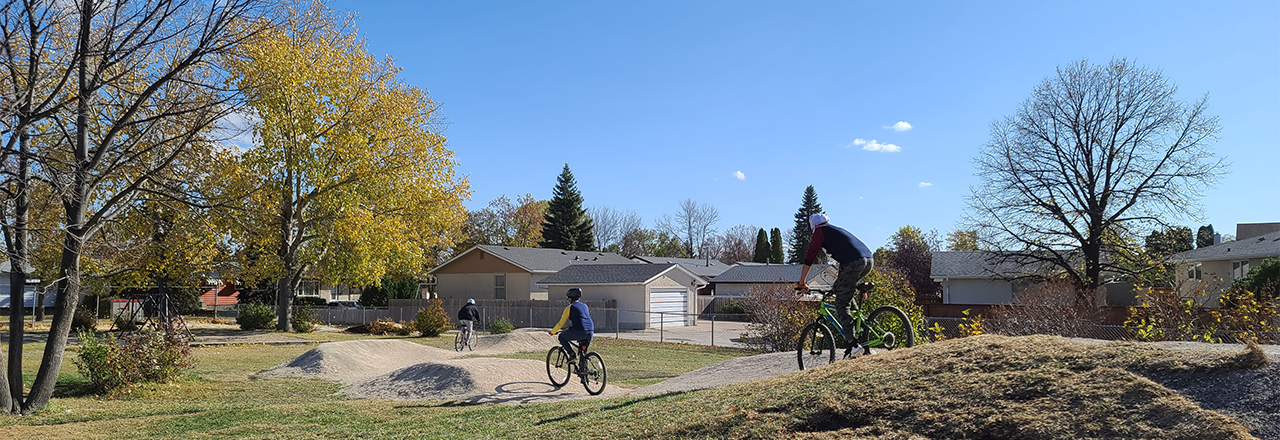
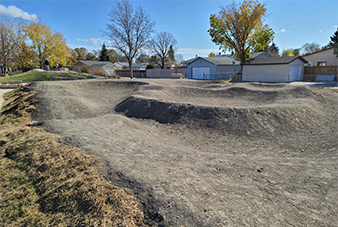
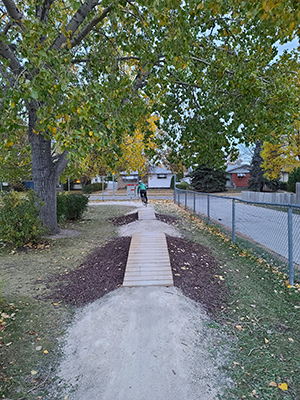
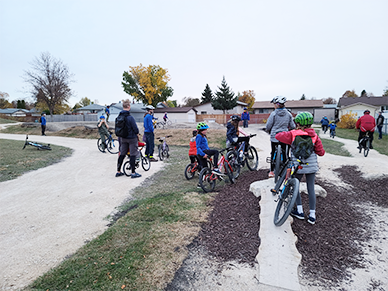
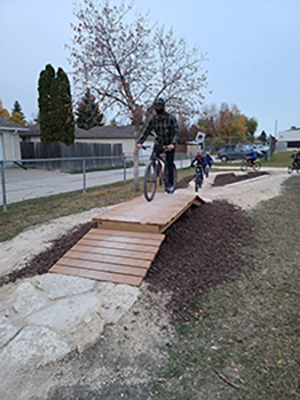
    This September, Arthur E. Wright Community School opened its Active Living Green Space: an all-ages and abilities (AAA) bike park and natural playground, and the first ever bike park in Canada constructed on school grounds. This unique amenity was built around the school’s existing soccer field and playground, creating an outdoor sports facility unlike any other in the area – and beyond.

    Completing this project marks over 18 months of collaboration between A.E. Wright, the Seven Oaks School Division, design firm Scatliff+Miller+Murray, and Urban Systems.

    “It started as one of those ideas that you put into the ether, you meet the right people, and it takes off from there,” says Urban Systems’ Jamie Hilland, sustainable transportation planner and project lead. “It went from an idea to fully-funded within a year, which is pretty fast for these types of projects. People were really drawn to the innovative aspect of it.”

    Designed to be a four-seasons facility, the Active Green Living Space integrates a multi-use trail with a diverse topography, biking features (including a pump track and snake run), and outdoor classroom spaces. The variety of features appeal to people as young as three years up to senior citizens.

    “We designed it as a nature playground-plus, because of the way it builds an active living component on top of its other outdoor classroom uses,” says Jamie. In the winter months, the looping trails and hilly terrain are ideal for tobogganing and cross-country skiing. “Make it fun. Make it flow. That was our mantra.”

    The goal of the Active Green Living Space is to promote outdoor recreation and improve community access to outdoor adventure spaces. A passion in active transportation has blossomed at A.E. Wright over the last few years, thanks in part to the Bike Education Skills and Training (BEST) program, a multi-year component of the school’s Physical Education curriculum which teaches students bike commuting skills and bike maintenance. Jamie helped to create the BEST program five years ago, in partnership with Manitoba Public Insurance, when he was with Green Action Centre, and the program is now active in 24 schools across Manitoba with planned future expansion. Arthur E. Wright also operates a bike library, where students without a bicycle of their own can borrow one at no cost.

    In early 2019, Jamie visited A.E. Wright to give students a presentation on complete streets, and afterwards met with principal Anna Mangano to discuss the initial idea for the bike park.

    “Anna was the driving force behind the project. She told me, ‘We really want to take it to the next level. How can we incentivize our kids to keep riding their bikes to school?’ I think it’s going to add a lot to their existing bike program.”

    With few affordable recreation options available to the Maples community, the concept of an innovative bike park, right in the school’s backyard, energized the community to make the project a reality.

    “In many communities, school grounds are now becoming true community facilities that are used beyond the typical 8-4 window of the school day. What this park does is allow for the broader community to access a fun outdoor space from sunup to sundown.”

    Urban Systems supported A.E. Wright through the grant application process and secured the project’s funding from the Seven Oaks School Division, City of Winnipeg, the Province of Manitoba, and the Winnipeg Foundation. Alex Man, a geological engineer from Scatliff+Miller+Murray, created the initial park concept and designed the trail itself. After obtaining the proper permitting (no small task for a project of this nature), construction of the park took place over the summer of 2020.

    Despite the lengthy approvals process involving many different stakeholders, there was widespread enthusiasm and support for the project, largely because of the positive impact it will have on the Maples neighbourhood.

    “Our hope and intention is to see A.E. Wright become a hotspot, and to become a school that people go to because you can get wicked bike skills and have a bike park in your backyard. They have a community that really prioritizes active school travel, and this project will help to support those efforts.”

    Jamie, an advocate for community cycling and a mountain biking coach himself, believes that A.E. Wright’s active living space will lead to similar projects cropping up across Canada. Active transportation professionals from across the country have already reached out to A.E. Wright and Jamie after seeing the park on social media and on CBC Manitoba.

    By showing that one bike-friendly neighbourhood can create and fund a vibrant recreation space on school grounds, other communities can also set a new standard for promoting active lifestyles and rethinking how school grounds are used by the wider community.

    “To see this park move from concept, to paper, to reality is amazing. We know what these types of spaces can offer. It not only emphasizes cycling as a mode of transportation but also as outdoor recreation. It is super fun on its own. The school and the City of Winnipeg are very excited to see the impact it brings, and so are we.”